

Core banking software in 2026: 14 platforms compared for banks, EMIs and PIs
Fourteen core banking platforms for banks, e-money and payment institutions, in alphabetical order: who each is for, how it is deployed, what it covers, where it sells, customers it names and published pricing, with a source for every fact. Not a ranking.
Disclosure. Finray publishes this page and Corebanq is Finray’s own core banking product. Under section 4 of Finray’s editorial methodology, Corebanq is recused: it is excluded from the comparison, it is not in the table or the profiles, and it is not ranked, scored or recommended. It is described separately at the end of the page. The same rule applies in Finray’s EU and UK PI/EMI core banking radar, which maps the same vendors to PSD2, PSD3, DORA and the EU anti-money laundering rules.
This overview is not a ranking. It compares 14 core banking platforms in alphabetical order, the 14 vendors in that radar. For each it records who the platform is for, how it is deployed, what it covers, where it is sold, customers the vendor names in public and pricing where it is published, with a link to the page that says so. Nothing here says one platform is better than another, and no pros or cons are added. Where a vendor publishes nothing on a point, the profile says so.
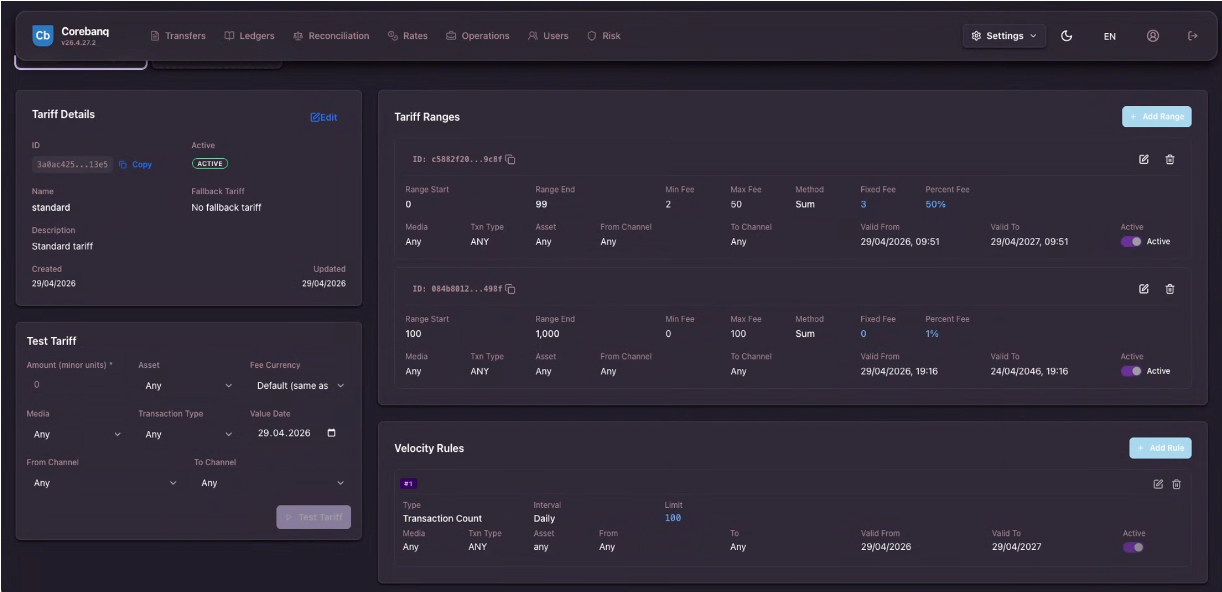
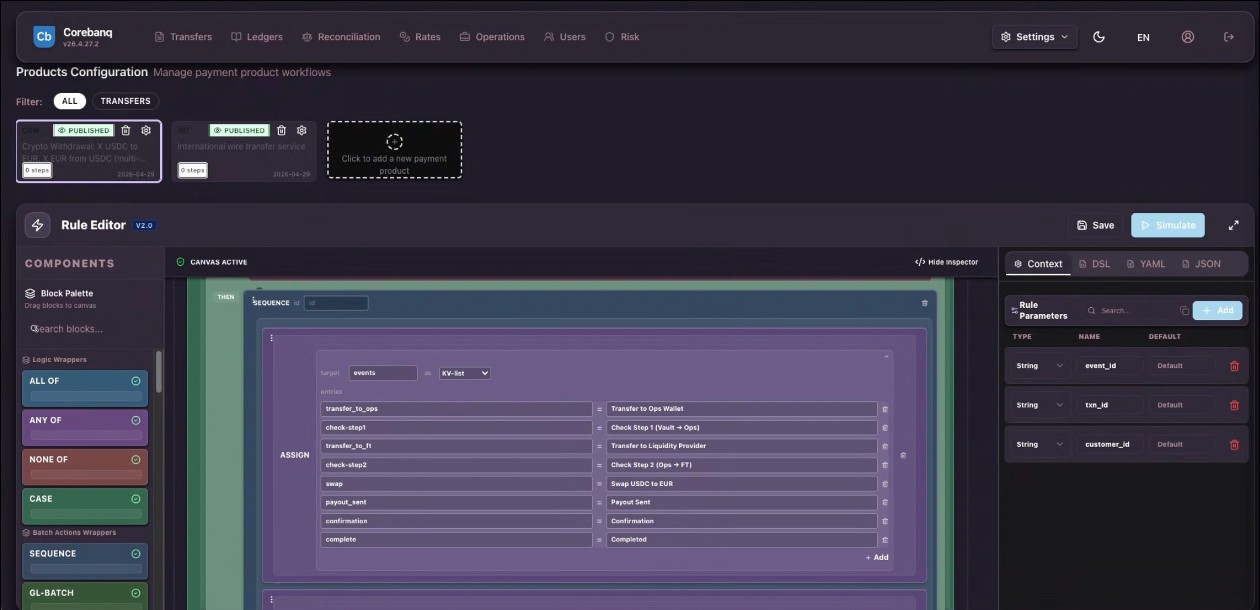
Status as of 23 November 2026: every vendor page cited below was read on that date. The page shows no other vendor’s screenshots or logos; each profile links to the vendor’s own website instead. The only product images are two Corebanq frames, shown with Finray’s own product at the end of the page.
What is core banking software?
Core banking software is the system of record for accounts and balances. It opens and closes accounts, holds the ledger, posts every transaction, applies fees and interest, and passes balances to payments, reporting and reconciliation. A bank runs deposits, and often lending, on it. An e-money or payment institution uses it for customer accounts and payment flows and for the records that show client money apart from the firm’s own money, which PSD2 Article 10 and, in the UK, the FCA’s safeguarding rules require.
Vendors sell the same idea under several names: core banking platform, cloud banking platform, banking engine, ledger. The name matters less than the boundary. Some platforms below include payment processing, cards or customer apps; others are a ledger and product engine that relies on partners for payment rails. The profiles say which, in the vendor’s own words. For the category itself, the parts of a core, end-of-day and real-time processing and how banks replace one, read what a core banking system is.
How was this list built?
The 14 vendors are the ones in the radar, which Finray first published in May 2026 and refreshed in November 2026. Corebanq, Finray’s own product, was considered and excluded from the comparison because Finray makes it; it is described separately at the end of the page.
Each profile uses the vendor’s own website first: product pages, client pages, press releases and pricing pages. Company announcements and press releases are used for corporate events such as acquisitions. Each fact links to the page that states it. A customer is named only where the vendor or its owner names it in public. Where a vendor publishes no price, the profile says so.
One profile is thinner than the others. Tuum’s website refuses automated access, and Finray does not work around such blocks, so Tuum’s own pages could not be read for this overview. The Tuum profile uses only sources that could be reached: the Estonian commercial register, LHV’s own releases and annual report, and Tuum’s listing on AWS Marketplace. What Tuum’s own site says about the institutions it serves, its deployment models, its regional offices, its regulatory scope and its other named customers is missing for that reason, and the profile says so.
What the profiles leave out is deliberate. There are no scores, no “best for” verdicts and no pros and cons, because a fair verdict needs the evidence a buyer collects in a tender, not marketing pages. For each vendor the radar records which evidence is still pending, and the core banking requirements checklist for EMIs and PIs lists what to ask for.
The 14 platforms at a glance
The table summarises the profiles below; the source for each cell is linked in the profile. “Prices” says whether the vendor publishes figures; “model only” means it describes how it charges without figures. Corebanq is not in the table; see the end of the page.
| Platform | Built for, in the vendor’s words | Deployment | Base and reach | Prices |
|---|---|---|---|---|
| 10x Banking | Retail banks, mutuals, specialty lenders, non-bank brands | Software as a service, cloud-native on AWS | London; UK, Asia-Pacific, Africa | No |
| Advapay (Macrobank) | Payment and e-money institutions, payment service providers, neobanks | Vendor-run service, licence in the customer’s environment, or source code | Offices in seven cities, including Amsterdam, London and Tallinn | Model only |
| Engine by Starling | Banks, credit unions, mutuals | Software as a service in a dedicated, vendor-managed environment | England and Wales; UK, Romania, Australia, New Zealand; an agreement in Canada | No |
| Finastra (Essence) | Institutions of all tiers, including building societies | Software as a service, cloud, hybrid or on-premises | London; more than 100 countries | No |
| Intellect Design Arena (eMACH.ai) | Consumer, wholesale, central and Islamic banks, credit unions, building societies | Cloud-provider agnostic; managed service in Asia | Chennai; Americas, Europe, UK, Middle East, Africa, Asia-Pacific | Model only |
| Mambu | Banks, lenders, fintechs | Software as a service on AWS, Google Cloud or Azure, dedicated or shared | Amsterdam; EMEA, Asia-Pacific, Latin America, North America | No |
| Pismo (a Visa company) | Tier 1 banks, retailers, neobanks | Software as a service on AWS, multi-region | São Paulo; USA, UK, India, Singapore | No |
| SaaScada | Banks, lenders, fintechs, banking-as-a-service providers | Managed service on AWS, a dedicated environment per client | London; Singapore hub | No |
| SDK.finance | Neobanks to corporate banking; EMIs, payment service providers, wallets | Subscription or source-code licence; on-premises or cloud | Lithuania and UK; clients from the EU to Central Asia | Yes |
| Skaleet | Banks, neobanks, payment service providers, regulated fintechs | Mainly software as a service in EU data centres; on-premises on request | Paris; 30 customers in 15 countries | No |
| Temenos | Banks of every size, credit unions | On-premises, cloud, or software as a service on Azure and AWS | Grand-Lancy, Switzerland; more than 150 countries | No |
| Thought Machine (Vault Core) | Tier 1 banks to fintechs | Public, private or hybrid cloud | London, New York, Singapore; more than 30 countries | No |
| Tuum | Not verified; see the profile | Software as a service, as listed on AWS Marketplace | Tallinn; Europe and the Middle East, per LHV Bank | No |
| Vodeno (UniCredit) | Banks, licence holders, businesses | Cloud platform; Google Cloud partner | Warsaw; banking layer from UniCredit | No |
How to read the profiles
Each profile has the same seven lines; Tuum’s has an eighth, on what could not be verified. For names the institutions the vendor says it serves. Deployment records how the vendor says the platform runs: as a service the vendor operates, in a private cloud, in the customer’s own cloud account or on the customer’s premises. Covers lists core capabilities in the vendor’s terms. Where gives the base and the regions or licences the vendor names. Customers lists institutions named in public as users. Pricing says whether a price or a pricing model is published. Product page is the link to use instead of a screenshot.
Platform profiles, A to Z
10x Banking
10x Banking, a London company, sells the 10x cloud core banking platform, which it describes as a managed core with pre-built product fundamentals.
- For: retail banks, mutual and member-owned institutions, specialty lenders and non-bank brands that embed financial services in their products (10x Banking home).
- Deployment: software as a service. 10x describes the platform behind Chase UK as a cloud-native core built entirely on AWS (Chase UK story).
- Covers: deposits, transactional accounts, loans, credit cards and mortgages (10x retail banking); real-time processing of financial events and the ledger (10x story); the ProductKit SDK and APIs for building products (10x cloud core banking).
- Where: headquartered in London with an office in Sydney, serving clients in the UK, Asia-Pacific and Africa (10x release, 23 June 2026). 10x states that it is not a bank and holds no banking licence (10x embedded finance).
- Customers: Chase UK, Old Mutual, West Brom Building Society and Westpac (10x story).
- Pricing: not published; 10x offers demos on request (book a demo with 10x).
- Product page: the 10x cloud core banking platform.
Advapay
Advapay sells Macrobank, a core banking system for payment and e-money businesses, under the company Advapay OÜ.
- For: payment institutions, electronic money institutions, payment service providers, neobanks and related fintech models (Macrobank core banking software).
- Deployment: a vendor-operated software service, a perpetual licence in an environment the customer controls, or source-code ownership (Macrobank core banking software).
- Covers: accounts, ledger and accounting, payments, fees, reporting, back-office workflows and customer channels (Macrobank core banking software); processing of CHAPS, Faster Payments, SEPA, SWIFT and internal payments (Advapay digital core banking).
- Where: offices in Amsterdam, London, Tallinn, Toronto, Belgrade, Madrid and Warsaw (Advapay contacts). Advapay notes that buying the software does not itself grant regulatory permissions or banking access (Macrobank core banking software).
- Customers: European SecurePay Center, behind the PayoNet brand (Macrobank core banking software), and Payver (Payver announcement).
- Pricing: no price list; Advapay says pricing is scoped per project and names three models: a monthly software subscription with no setup fee, a licence with a setup fee, or source code at a fixed cost (Advapay digital core banking).
- Product page: Macrobank core banking software.
Engine by Starling
Engine is the software business of the Starling group: the banking platform Starling Bank runs on, sold to other banks as a service.
- For: banks, credit unions and mutuals, including new digital banks, existing banks, digital SME banks and modern mutuals (Engine platform).
- Deployment: software as a service, cloud-native, built and fully managed by Engine in a dedicated environment (Engine platform).
- Covers: the ledger, a configurable lending engine, payments, customer management and an in-house card processor (Engine core banking).
- Where: Engine by Starling Limited is registered in England and Wales (Engine home). Engine names banks it supports in the UK, Romania and Australia, calls SBS Bank its first client in New Zealand, and says it announced its first North American agreement, with Canada’s Tangerine Bank (SBS Bank announcement). The licensed bank in the group is Starling Bank; Engine is the group’s software-as-a-service provider (same source).
- Customers: Salt Bank in Romania (Salt case study), AMP in Australia (AMP case study), Tangerine in Canada, under a 10-year agreement announced on 4 November 2025 (Tangerine agreement) and SBS Bank in New Zealand (SBS Bank announcement).
- Pricing: not published; enquiries go to Engine’s contact form (contact Engine).
- Product page: Engine core banking.
Finastra
Finastra sells Finastra Essence, a core banking system from its Universal Banking business, with Essence Analytics as a separate data product.
- For: financial institutions of all tiers, including digital challengers, fintechs, established banks and building societies (Finastra Essence).
- Deployment: software as a service, cloud, hybrid or on-premises from a single code base (Finastra Universal Banking). Essence Analytics runs on Power BI and Azure Databricks (Essence Analytics).
- Covers: deposits, lending, payments, accounts, limits, fees and servicing, with a no-code product composer and configurable business rules (Finastra Essence).
- Where: Finastra is headquartered in London, with offices and clients in more than 100 countries (Finastra home). On 19 June 2026 Pollen Street Capital announced that it will acquire Universal Banking, Finastra’s core banking business, which will then operate as an independent business; the announcement made completion subject to regulatory approvals (Finastra press release).
- Customers: Tonik Bank (Tonik story), BKN301 Group (BKN301 story) and Melton Building Society (Finastra Universal Banking).
- Pricing: not published; enquiries go to Finastra’s sales contact (Finastra contact).
- Product page: Finastra Essence.
Intellect Design Arena
Intellect Design Arena, registered in Chennai, sells eMACH.ai Consumer Core Banking, the retail core it earlier sold under the iGCB name, alongside corporate and central banking cores.
- For: consumer, wholesale, central, Islamic, neo and digital, co-operative banks, credit unions, mutuals and building societies, among the segments its site lists (Intellect home).
- Deployment: a technology stack that Intellect describes as agnostic to the cloud service provider (eMACH.ai Consumer Core Banking); in November 2026 Intellect launched eMACH.ai Cloud for banks in Asia as a fully managed software service (Intellect release, 18 November 2026).
- Covers: savings and deposit accounts, payments and remittances, cash and teller services, debit card management, pricing policies and the general ledger, with an API-led platform and real-time consolidated positions (eMACH.ai Consumer Core Banking).
- Where: a footprint spanning the Americas, Europe, the UK, the Middle East and Africa, India, Asia-Pacific and Australia and New Zealand (Intellect home). The product page cites one of the UK’s oldest private banks, unnamed, as a user of the eMACH.ai platform (eMACH.ai Consumer Core Banking).
- Customers: OTP Bank in Hungary, which chose Intellect Digital Core in December 2023 (OTP Bank release), Cargills Bank in Sri Lanka (Cargills Bank release) and Ayeyarwady Farmers Development Bank in Myanmar (Ayeyarwady release).
- Pricing: no figures published; the Asian eMACH.ai Cloud offer is a pay-as-you-grow subscription (Intellect release, 18 November 2026).
- Product page: eMACH.ai Consumer Core Banking.
Mambu
Mambu sells a cloud banking platform, a configurable and API-first core, with payments from its acquisition of Numeral.
- For: banks, lenders and fintechs (Mambu cloud banking platform); its site also lists neobanks, credit unions and non-financial institutions (Mambu home).
- Deployment: software as a service on AWS, Google Cloud or Azure, in regions chosen for regulatory and data-residency needs, in a dedicated or a shared environment (Mambu cloud services).
- Covers: current accounts and savings in real time (Mambu cloud banking platform); loan and savings accounts, a general ledger and a streaming API (Mambu APIs); payments connected to schemes and partner banks (Mambu payments). Mambu acquired Numeral, a French payment technology provider, in December 2024 (Mambu press release), and its documentation says the older Mambu Payment Gateway is discontinued in favour of Mambu Payments (Mambu Payments documentation).
- Where: live across EMEA, Asia-Pacific, Latin America and North America (Mambu cloud banking platform); offices include Amsterdam, where Mambu B.V. is registered (Mambu offices).
- Customers: Western Union, OYAK ANKER Bank, Akbank AG and BankB (Mambu customers).
- Pricing: not published; enquiries go through Mambu’s contact page (contact Mambu).
- Product page: the Mambu cloud banking platform.
Pismo
Pismo, headquartered in São Paulo, sells a cloud-native core banking and card issuing platform. Visa completed its acquisition of Pismo in January 2024 (Visa release).
- For: tier 1 banks, major retailers and neobanks (Pismo home); large banks, marketplaces and fintechs (about Pismo).
- Deployment: a cloud-native software service built on multi-region infrastructure from Amazon Web Services (Pismo core banking).
- Covers: real-time balances per transaction, an API library with hundreds of endpoints and transaction banking for corporate customers (Pismo core banking); issuing of credit, debit and prepaid cards for Visa, Mastercard and private labels (Pismo home).
- Where: headquartered in São Paulo with offices in the USA, the UK, India and Singapore (about Pismo).
- Customers: BTG Pactual for its retail bank and Citi Treasury and Trade Solutions (Pismo home).
- Pricing: not published; enquiries go through Pismo’s contact page (contact Pismo).
- Product page: Pismo core banking.
SaaScada
SaaScada, with its registered office in London, sells a cloud-native core banking platform built on an event-sourced ledger.
- For: banks, lenders, fintechs and banking-as-a-service providers (SaaScada core banking platform).
- Deployment: managed software as a service hosted on Amazon Web Services, with a dedicated environment for each client and control over data residency (SaaScada security and resilience).
- Covers: deposits, lending, payments and Islamic banking features, an event-sourced ledger that keeps an immutable audit log, and an API-first architecture (SaaScada core banking platform).
- Where: registered in London, with a regional hub in Singapore for Asia-Pacific (SaaScada Singapore announcement). SaaScada states that it is ISO/IEC 27001:2022 certified and holds a SOC 2 Type II attestation (SaaScada security and resilience).
- Customers: Allica Bank in the UK, Relio in Switzerland and Solance in Ireland (SaaScada clients); SME Bank in Lithuania went live in November 2026 (SME Bank announcement).
- Pricing: not published; SaaScada offers a prototyping environment paid by the hour (SaaScada home).
- Product page: the SaaScada core banking platform.
SDK.finance
SDK.finance is the trading name of TechFin UAB, a Lithuanian company, and sells a transaction platform and a separate general ledger, both white-label.
- For: neobanks to corporate banking, in its own words (SDK.finance core banking software); digital wallets, payment service providers, EMIs, neobanks, remittance apps and embedded finance platforms for the ledger (SDK.finance real-time ledger).
- Deployment: a software subscription or a source-code licence (SDK.finance pricing); on-premises or in the cloud (SDK.finance core banking software). Under the subscription, SDK.finance hosts the application and the customer manages the databases (SDK.finance pricing).
- Covers: accounts, wallets, payment workflows and back-office operations, and a standalone ledger that turns business events into double-entry journal entries (SDK.finance home); cards and IBANs linked to accounts and fee and limit configuration (SDK.finance core banking software).
- Where: registered in Lithuania, with a UK presence through TechFinUK LTD and clients in the EU, the UK, the US, Canada, the Middle East, Africa and Central Asia (about SDK.finance). SDK.finance states that it is not a bank, financial or payment institution (SDK.finance pricing).
- Customers: Geidea (Geidea case study), Nebeus (Nebeus case study) and TheOneGate (TheOneGate case study).
- Pricing: published. The transaction platform subscription is listed at €10,000 for the first three months, then €5,500 a month plus €0.05 per transaction; the general ledger at €2,500 a month plus €0.05 per posted ledger event after three months; the source-code licence is priced on request (SDK.finance pricing).
- Product page: SDK.finance core banking software.
Skaleet
Skaleet, a Paris company, sells a modular core banking platform for banks and regulated fintechs.
- For: traditional banks and disruptors (about Skaleet); traditional and universal banks, neobanks, payment service providers and banking-as-a-service providers (Skaleet core banking switch).
- Deployment: primarily a cloud-based software service, with on-premises delivery for specific demands (Skaleet FAQ); hosted in EU-based data centres that Skaleet says are not subject to the US Cloud Act (Skaleet home).
- Covers: accounts and cards, SEPA and SEPA Instant managed natively, ISO 20022, a lending module across the loan lifecycle, and a card module that connects to the customer’s issuer processor (Skaleet offering).
- Where: headquartered in Paris; Skaleet says it has onboarded 30 customers in 15 countries since its first implementation in 2015 (about Skaleet).
- Customers: Crédit Agricole for a European savings platform (Crédit Agricole story), Caisse d’Epargne Hauts de France for its corporate offer in the Netherlands (Caisse d’Epargne story), SSP (SSP story) and Monnaie de Paris (Monnaie de Paris story).
- Pricing: not published; Skaleet describes modules bought as the customer grows (Skaleet FAQ).
- Product page: the Skaleet offering.
Temenos
Temenos AG, listed on the SIX Swiss Exchange and based in Grand-Lancy near Geneva, sells Temenos Core, the product its developer pages still call Transact.
- For: banks of every size, across retail, business, corporate, treasury and Islamic banking (Temenos core banking), and credit unions and community banks (Temenos for credit unions).
- Deployment: on-premises, in the cloud or as a software service (about Temenos); Temenos SaaS is delivered on Microsoft Azure and Amazon Web Services (Temenos SaaS).
- Covers: retail, corporate, treasury, wealth and payments functions with open APIs (Temenos core banking APIs); compliance, financial risk management and analytics, and AI agents in operations (Temenos core banking).
- Where: banks in more than 150 countries (Temenos core banking); Temenos says its SaaS supports banks operating under more than 30 regulators (Temenos SaaS).
- Customers: Kingdom Bank in the UK, live on Temenos SaaS (Kingdom Bank release); Charity Bank in the UK, which selected Temenos Core and Payments as SaaS in November 2026 (Charity Bank release); Vancity in Canada (Vancity release).
- Pricing: not published; the core banking page offers a sales contact (contact Temenos).
- Product page: Temenos core banking.
Thought Machine
Thought Machine, a London company, sells Vault Core, a cloud-native core banking engine, and Vault Payments.
- For: financial institutions from tier 1 banks to fast-growing fintechs (Vault Core).
- Deployment: cloud-agnostic, offered through public cloud, private cloud or a hybrid model (Thought Machine partners), across multi-cloud environments (Vault Core).
- Covers: retail, SME and corporate banking on a single ledger (Vault Core); payments processed natively as ISO 20022 messages (Thought Machine on Vault Payments), with rails that include Faster Payments, Bacs, TIPS, Fedwire, FedACH, Mastercard and Visa (Vault Payments).
- Where: regional hubs in London, New York and Singapore and offices in Lisbon, Miami and Sydney (Thought Machine story); clients in more than 30 countries (Thought Machine release).
- Customers: Lloyds Banking Group (Thought Machine story), Intesa Sanpaolo for isybank (Intesa Sanpaolo case study), Trust Bank in Singapore (Trust Bank case study) and Deutsche Bank, which signed a global licensing agreement in 2026 (Deutsche Bank release).
- Pricing: not published; Thought Machine offers demos on request (Thought Machine demo).
- Product page: Vault Core.
Tuum
Tuum is the trademark of Modular Technologies OÜ, a private limited company in Tallinn entered in the Estonian commercial register on 5 February 2019, with computer programming as its activity (e-Business Register; LHV Group annual report 2022). Tuum’s own website refuses automated access, so this profile uses only the sources described under how this list was built.
- For: not verified for this overview. LHV Bank describes Tuum’s platform as one “that supports multiple business lines from a single system” (LHV Bank, 7 September 2023).
- Deployment: listed by Tuum on AWS Marketplace as software as a service (Tuum on AWS Marketplace); LHV Bank calls Tuum its “SaaS partner” and the platform “cloud-native” (LHV Bank, 7 September 2023).
- Covers: modules for accounts, lending, cards and payments (Tuum on AWS Marketplace).
- Where: registered in Tallinn (e-Business Register); LHV Bank says Tuum “operates across Europe and the Middle East” (LHV Bank, 7 September 2023).
- Customers: LHV. In March 2022 LHV said that Tuum “will be the main service provider for the bank’s main system” in the United Kingdom (LHV, 23 March 2022), and in September 2023 LHV Bank moved its SME lending onto Tuum (LHV Bank, 7 September 2023). LHV Group reported a 1.4% interest in Tuum in its 2022 annual report (LHV Group annual report 2022).
- Pricing: not published; the AWS Marketplace listing says pricing “is based on the duration and terms of your contract with the vendor” (Tuum on AWS Marketplace).
- Not verified: what Tuum’s own website says about the institutions it serves, its deployment models, its regional offices, its regulatory scope and its other named customers. Ask Tuum directly.
- Product page: Tuum.
Vodeno
Vodeno, a Warsaw company, sells the Vodeno Cloud Platform for banking as a service. UniCredit completed its acquisition of Vodeno and Aion Bank on 7 March 2025 (UniCredit release).
- For: any bank, licence holder or business (Vodeno Cloud Platform); Vodeno offers banking as a service to regulated and non-regulated entities (Vodeno home).
- Deployment: a cloud platform; Vodeno states that it is a certified Google Cloud partner and that its solutions are supported by the Google Cloud ecosystem (Vodeno Cloud Platform).
- Covers: core banking built on smart contracts for payments, transfers, lending and savings management (Vodeno Cloud Platform); accounts, lending and card issuing and processing in partnership with Mastercard (Vodeno home).
- Where: Vodeno Sp. z o.o. is based in Warsaw; Vodeno delivers the platform in cooperation with UniCredit NV/SA, which provides the regulated banking layer (Vodeno contact).
- Customers: UniCredit, which said on completion that it now has access to the cloud-based platform and named banking as a service for selected fintechs among its aims (UniCredit release).
- Pricing: not published; Vodeno offers demos on request (Vodeno contact).
- Product page: the Vodeno Cloud Platform.
What the profiles do not tell you
Marketing pages describe capability; a supervisor asks for evidence. For an e-money or payment institution the gap usually sits in six places, the same six domains the radar uses. Finray’s own pages on a core banking system for e-money institutions and a core banking system for payment institutions set out what each licence asks of the core, rule by rule, with the primary text for each.
- Ledger and safeguarding. Can the platform show relevant funds apart from own funds at any time, per currency, with corrections made by reversal rather than by editing? Ask for a sample of the records, not a slide. The safeguarding reconciliation note sets out the daily comparison.
- Payment rails. Which schemes does the platform reach itself, which through a sponsor bank or partner, and which as files? The answer decides who is responsible when a payment fails, and for euro-area institutions it decides how the instant payment dates of April 2027 that the radar sets out will be met. The PSD3 and PSD2 note covers the rule changes ahead.
- API and strong customer authentication. Ask for the specification, the authentication flows, idempotency rules, rate limits and sandbox terms.
- Resilience and outsourcing. The contract must carry the clauses DORA Article 30 lists, and the firm must be able to fill its register of information. The DORA exit strategy note covers the exit plan.
- Audit and observability. Who can read the logs, for how long, and in what format can an auditor or an insolvency practitioner get them?
- Commercial and delivery fit. Pricing basis, licence model, implementation timeline and the cost of leaving. The core banking cost drivers note lists what makes up the bill.
The radar records, for each vendor, which of these points public evidence does not yet cover. Those gaps are questions to ask in a tender, not findings against any vendor.
SaaS, private cloud or on-premises?
The deployment line in each profile is the first filter many buyers apply. Some platforms here are offered only as a service the vendor runs; others offer a choice between a hosted service, a dedicated single-tenant environment and installation in the customer’s own data centre or cloud account. No regulator prefers one model. DORA and the EBA outsourcing guidelines keep the accountability with the regulated firm in every case. What changes is who holds the evidence a supervisor asks for: infrastructure logs, access records, backup tests and the data needed to leave. The single-tenant and multi-tenant core banking note and the deployment topology radar set out that trade-off.
Finray’s products in this space: Corebanq
Disclosure. Finray makes Corebanq and publishes this page. Under section 4 of Finray’s editorial methodology, Corebanq is excluded from the comparison above: it is not in the table or the profiles, and nothing here ranks, scores or recommends it. The lines below repeat only what Finray already publishes about Corebanq.
- For: Swiss FINMA-licensed institutions and FinTech firms, EU and EEA payment and e-money institutions, UK payment and e-money institutions regulated by the FCA, and Canadian payment service providers and money services businesses (Corebanq).
- Deployment: three models: Cloud SaaS (multi-tenant, managed), Private SaaS (single-tenant cloud with dedicated infrastructure) and Enterprise Licence (on-premises or private cloud with a perpetual licence); customer-managed keys on request (Corebanq deployment).
- Covers: an atomic double-entry ledger that rejects any unbalanced posting, accounts partitioned by currency, entity and ledger, payment operations on SIC, SEPA, SWIFT and instant rails, continuous reconciliation, ISO 20022 messaging and an append-only event stream that is also the audit trail (Corebanq). A public API reference covers authentication and endpoints for users, customers, accounts and transactions (Corebanq API reference).
- Where: Finray Technologies Ltd is a software company, not a bank, payment institution or e-money institution; Corebanq runs inside the customer’s regulatory perimeter (Corebanq FAQ).
- Pricing: not published; Finray states that it does not publish a price list yet (Corebanq deployment).
Corrections
Vendors and readers can send factual corrections to legal@finray.tech with the URL, the disputed fact and the supporting evidence. Finray corrects factual errors and does not edit on commercial grounds; the editorial methodology explains the conflict-of-interest rules that apply to Corebanq. This overview is general information, not legal or procurement advice.
Frequently asked questions
- What is core banking software?
- Core banking software is the system of record for accounts and balances. It opens and closes accounts, holds the ledger, posts every transaction, applies fees and interest, and passes balances to payments, reporting and reconciliation. For an e-money or payment institution it also carries the records that show client money apart from the firm's own money.
- What core banking software does an e-money institution need?
- One that keeps e-money holders' funds separable from the firm's own funds at any time, with accounts and reconciliation per currency, corrections made by reversal, access to payment rails directly or through a partner, support for strong customer authentication and an audit trail an auditor can read. The safeguarding rules for e-money, Article 7 of the E-Money Directive in the EU and CASS 15 in the UK, set the duties behind these needs. In this overview Advapay and SDK.finance name EMIs among the firms they serve. Ask any of them for evidence, not a description.
- What should a core banking RFP checklist include?
- Rows that ask the vendor to show evidence rather than describe features: ledger integrity and correction by reversal, separation of client funds, reconciliation per currency, which payment schemes the platform connects to itself and which through a partner, the API specification and strong customer authentication flows, the contract clauses DORA Article 30 lists, audit and access rights, a tested exit plan, the pricing basis and the implementation timeline. Finray's requirements checklist for EMIs and PIs lists each row with the rule behind it and comes with a CSV copy.
- Is SaaS or on-premises core banking better for a regulated firm?
- Regulators do not prefer either. Software as a service moves the running of the system to the vendor and is usually quicker to start. On-premises or single-tenant deployment keeps infrastructure, logs and data inside the firm's perimeter but needs mature controls to run. Under DORA and the EBA outsourcing guidelines the firm stays accountable in both models, so the practical question is who holds the evidence a supervisor will ask for. In this overview some vendors offer only software as a service and others offer several models.
- What does DORA require when core banking is outsourced?
- DORA has applied since 17 January 2025 and covers payment and e-money institutions as well as banks. The firm stays fully responsible for the service (Article 28(1)), records the arrangement in its register of information (Article 28(3)) and needs documented, tested exit strategies for services that support critical or important functions (Article 28(8)). Article 30(2) lists the contract terms for every ICT service, and Article 30(3) adds terms, including audit rights and an exit strategy with a transition period, where the service supports a critical or important function.
- Is this list a ranking?
- No. The 14 platforms appear in alphabetical order and none is scored or recommended. Finray publishes this page and Corebanq is Finray's own core banking product, so under Finray's editorial methodology Corebanq is recused: it is left out of the comparison and described separately at the end of the page, as in Finray's EU and UK PI/EMI core banking radar.
Sources
- Finray Intelligence: EU/UK PI/EMI core banking selection radar (updated 23 November 2026)
- Regulation (EU) 2022/2554 (DORA), Articles 2, 28 and 30, on EUR-Lex, accessed 23 November 2026
- EBA Guidelines on outsourcing arrangements, EBA/GL/2019/02, accessed 23 November 2026
- Directive (EU) 2015/2366 (PSD2), Article 10 (safeguarding), official copy on legislation.gov.uk, accessed 23 November 2026
- FCA: Payments and Electronic Money (Safeguarding) Instrument 2025 (FCA 2025/38), CASS 15, accessed 23 November 2026
- 10x Banking: cloud core banking platform, accessed 23 November 2026
- Advapay: Macrobank core banking software, accessed 23 November 2026
- Corebanq: public API reference, accessed 23 November 2026
- Engine by Starling: core banking, accessed 23 November 2026
- Finastra: Finastra Essence, accessed 23 November 2026
- Finastra: Pollen Street Capital to acquire Universal Banking (19 June 2026), accessed 23 November 2026
- Intellect Design Arena: eMACH.ai Consumer Core Banking, accessed 23 November 2026
- Mambu: cloud banking platform, accessed 23 November 2026
- Pismo: core banking, accessed 23 November 2026
- Visa: Visa completes acquisition of Pismo (January 2024), accessed 23 November 2026
- SaaScada: core banking platform, accessed 23 November 2026
- SDK.finance: pricing, accessed 23 November 2026
- Skaleet: global offering, accessed 23 November 2026
- Temenos: core banking, accessed 23 November 2026
- Thought Machine: Vault Core, accessed 23 November 2026
- Estonian e-Business Register: Modular Technologies OÜ (14655118), accessed 23 November 2026
- AS LHV Group: Annual Report 2022, accessed 23 November 2026
- LHV: LHV applies for a banking licence in the United Kingdom (23 March 2022), accessed 23 November 2026
- LHV Bank: LHV Bank introduces an upgraded SME Lending system (7 September 2023), accessed 23 November 2026
- AWS Marketplace: Tuum, listed by Tuum, accessed 23 November 2026
- Vodeno: Vodeno Cloud Platform, accessed 23 November 2026
- UniCredit: UniCredit completes acquisition of Aion Bank and Vodeno (7 March 2025), accessed 23 November 2026
Read next
Discuss how this applies to your institution with the Finray team.
Book a briefing