

For payment and e-money institutions.
EU/EEA and UK PI/EMI · Canadian MSB/FMSB and RPAA-regulated PSP firms
Safeguarded funds are reconciled every day, supervisors ask for evidence, and the DORA register and transaction monitoring have to hold up. Here is where each problem is documented, and which platform answers it.
What happens after you book
- A team member will respond within one business day with availability windows.
- Corebanq runs as Cloud SaaS, Private SaaS or an Enterprise Licence.
- After the briefing, the full Corebanq and XZiel API references are issued with test-environment access.
- Due-diligence documents, such as a summary of the April 2026 independent penetration test, are available under NDA.
Payment institutions and e-money institutions authorised in the EU/EEA or by the FCA in the United Kingdom.
They hold customer funds that must be safeguarded and reconciled, they answer to a national competent authority, and many are applying for an authorisation or keeping one. The firm remains the regulated entity; Finray's software runs inside its perimeter.
The problem, its source, and the platform that answers it.
-
Safeguarding reconciliation is a daily discipline.
Under PSD2 Article 10, EMD2 Article 7 and FCA PS25/12, safeguarded funds are reconciled every day. In the UK, the daily internal and external reconciliations and the D+1 comparison each need data lineage, an exception workflow and evidence of who owns them.
Corebanq reconciles continuously against statement feeds through the day. Verified, potential-mismatch and unreconciled items become operator tasks as soon as they appear: auto-matched against the general ledger where the rules are deterministic, escalated where human judgement is required.
The ledger rejects any posting whose debits and credits do not balance, accounts are partitioned by currency, entity and ledger at the schema level, and every action carries the actor and the policy version.
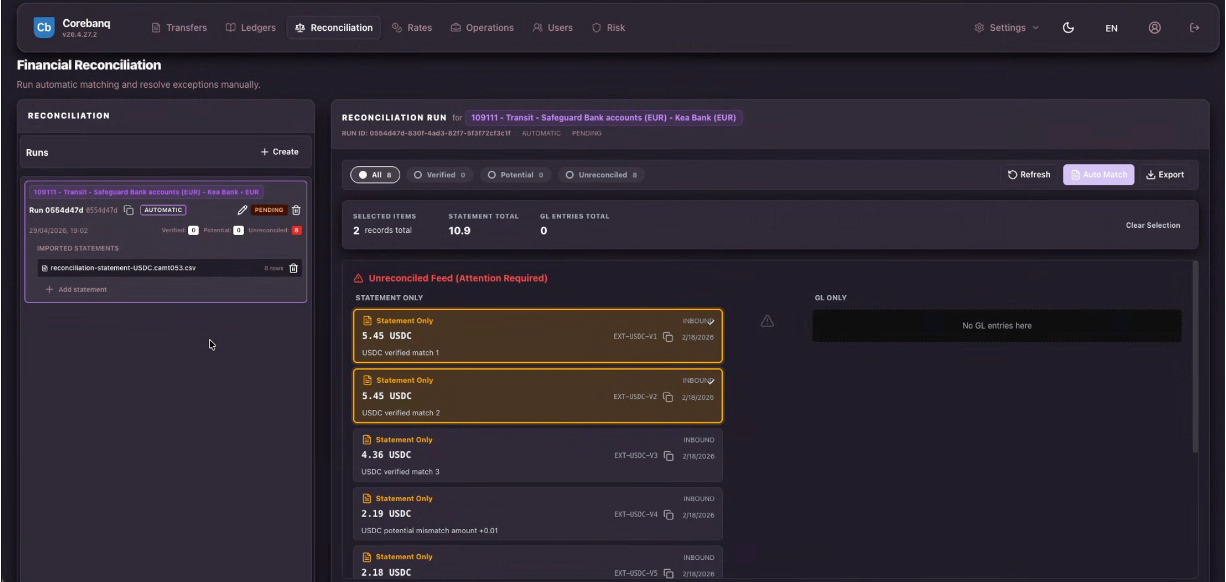
Corebanq financial reconciliation. Representative UI capture · synthetic values · not a live customer environment. -
Supervisors ask for evidence.
Our EMI and PI licensing register maps 571 successful records at its 2 May 2026 cut-off. Its reading: weak applicants fail or stall because they ask the supervisor to trust assertions; successful applicants supply evidence. A separate register maps 64 named authorisation withdrawals across four regulator populations (extraction 3 May 2026, one FCA Final Notice added 21 November 2026).
Ordinis records evidence as the work is done. Each control is a record with an owner and a version, and it can be queried. Approvals that need several people move through defined states, and each step is recorded. Policy changes reach the controls below them with a written approval record.
On the ledger side, Corebanq's append-only event stream is both the record that runs operations and the audit trail, so no separate audit-trail report is generated.
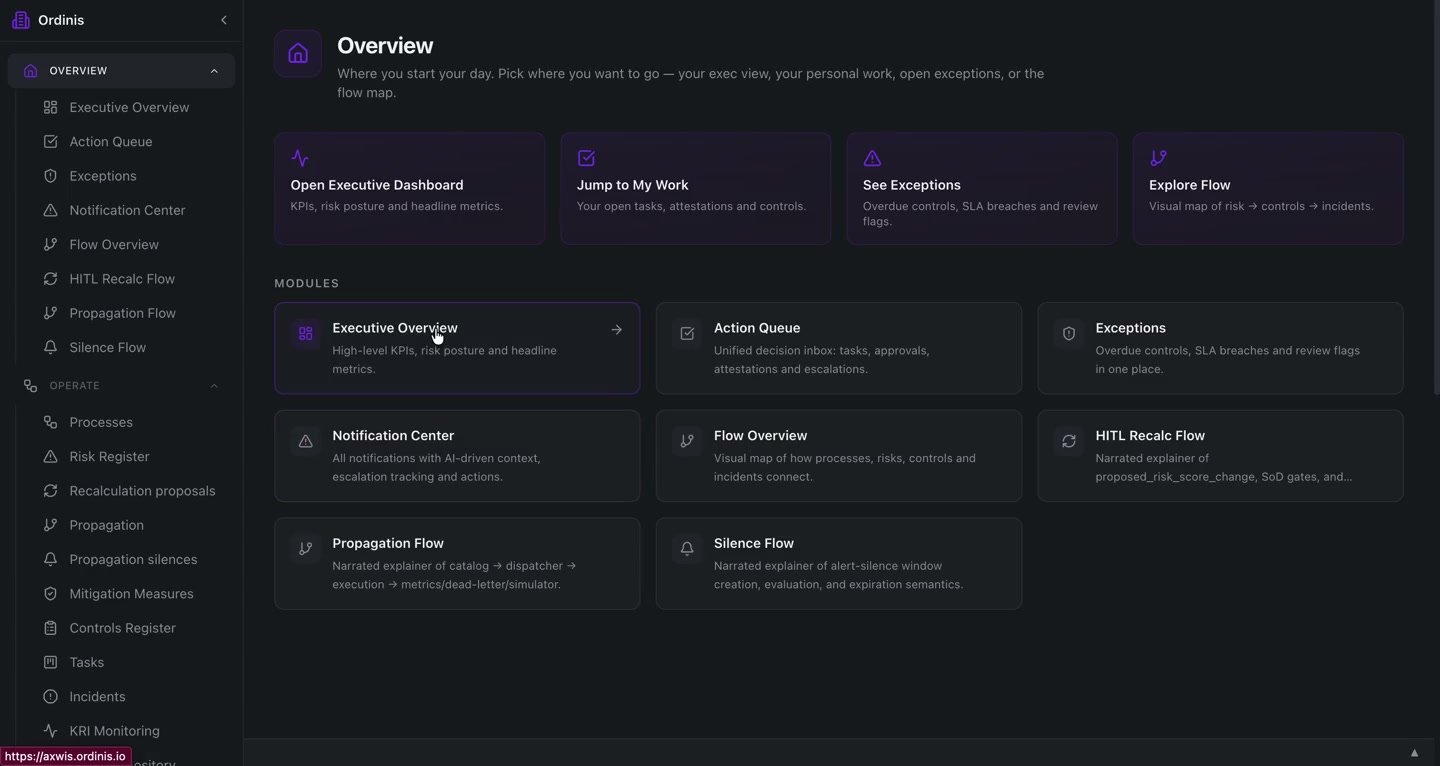
Ordinis executive overview. Representative UI preview · values synthetic · not a live customer environment. -
The DORA register of information has to be complete and correct.
For EU/EEA firms, DORA Article 28(3) requires a register of information covering all contractual arrangements with ICT third-party service providers, available to the competent authority on request. In the 2024 ESAs dry run, 6.5% of submitted registers passed all data-quality checks.
Ordinis keeps the vendor and AI inventory up to date through the year, with evidence recorded each time something changes.
Each control around it is a record with an owner and a version that can be queried, and its evidence is recorded as the work is done.
-
Transaction monitoring has to be tuned and explainable.
In the weak-control dataset behind our EMI and PI licensing register (revocations, Final Notices and other public enforcement), AML/CFT failure is present in roughly half of the verified rows: paper-only risk assessments, un-tuned transaction monitoring, weak enhanced due diligence and gaps in suspicious activity reporting. In the EU, AMLR applies from 10 July 2027.
XZiel's decisions come mainly from a deterministic rule engine. Rule changes ship with history, review and rollback, and every rule hit can be reproduced from its inputs alone. Where ML is used, each signal comes with the features that produced it.
Sanctions, PEP and adverse-media screening records the source list in force at each match, and every alert moves through assignment, review, decision and close, ending in a structured decision record.
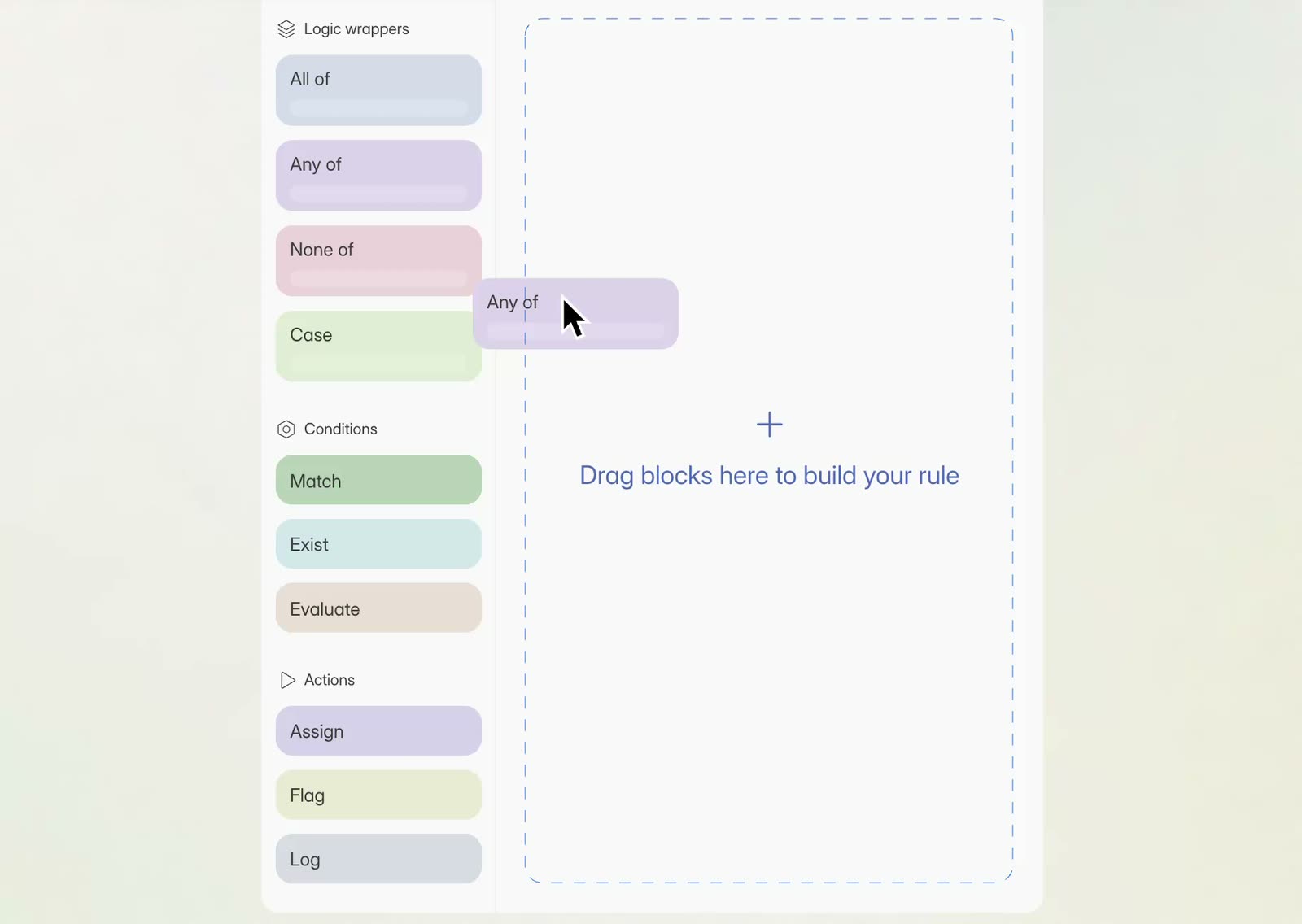
XZiel visual rule builder. Representative UI preview · primitives illustrative · full block library and saved typologies in product.

What you can check.
-
ISO/IEC 27001:2022
Company-level ISMS certification by NQA under UKAS accreditation, certificate No. 215646, valid 21 Oct 2025 – 21 Oct 2028. The 2026 surveillance audit was passed.
View the certificate -
Independent penetration test
A summary of the April 2026 independent penetration test is available under NDA.
Corebanq security -
Primary-source radars
The safeguarding, licensing, withdrawal and DORA radars cite the regulator sources they are built from, with access dates. Finray products are recused from best-of rankings, vendor scorecards and comparison tables.
How the radars are built
Frequently asked questions.
-
How does Corebanq handle reconciliation?
Reconciliation runs continuously through the day. Each discrepancy becomes a task the operator can act on as soon as it appears. There is no end-of-day reconstruction step.
-
Which Corebanq deployment suits a PI or EMI?
Cloud SaaS is a multi-tenant managed deployment for EMIs, PIs and smaller FinTechs that want minimal IT overhead. Private SaaS is a single-tenant cloud with dedicated infrastructure for larger EMIs and PIs that need enhanced data isolation. An Enterprise Licence covers on-premise or private-cloud deployment.
-
Is Finray a payment institution or an e-money institution?
No. Finray is a software infrastructure provider, not a bank, payment institution or e-money institution. The licensed firm operates Finray's software within its own regulatory perimeter and remains responsible for the regulated activity.
-
Do the radars rank Corebanq?
No. On the safeguarding, licensing and withdrawal radars, Corebanq is recused from ranking. Each radar cites the regulator sources it is built from.
Solutions for other clients
-
Swiss banks and FinTechs
FINMA-supervised banks and Art. 1b FinTech institutions.
-
Crypto-asset service providers
MiCA crypto-asset service providers and UK cryptoasset firms.
-
Swiss companies
Companies that keep their own books, and their accountants and fiduciaries.
-
All solutions
Every client type on one page.
Bring one safeguarding or authorisation problem.
A reconciliation break, an authorisation file, a vendor inventory or a monitoring backlog. We will walk through it with the platform that answers it.