

For Swiss portfolio managers and trustees.
Portfolio managers and trustees licensed by FINMA under FinIA
Compliance software for Swiss asset managers has to keep what the supervisory organisation and the audit firm ask to see: directives with their versions, controls with owners, approvals and the evidence of each review. Here is what the rules require, where each duty is set out, and how Ordinis records it.
Last updated .
What happens after you book
- A team member will respond within one business day with availability windows.
- In the briefing we walk through your problem with the platform that handles it.
- Full rule definitions, model inputs and audit-chain contracts are shared under NDA during the evaluation window.
Portfolio managers and trustees licensed by FINMA under the Financial Institutions Act (FinIA), often called independent or external asset managers.
About 1,600 firms hold this licence. FINMA's lists, updated 22 November 2026, name 1,509 portfolio managers and trustees monitored by a supervisory organisation and 90 domestic group companies that FINMA supervises directly. Ongoing supervision of the 1,509 sits with one of four supervisory organisations: AOOS, OSFINcontrol, SO-FIT and OSIF. The firm remains the licensed entity; Ordinis is software it runs.
Status as of 22 November 2026: the two-tier model of FINMA and supervisory organisations is in force. A parliamentary postulate and a working group are reviewing it, and no bill exists.
What compliance software for Swiss asset managers has to keep on record.
-
The supervisory organisation rates the firm in three areas.
FINMA's risk assessment system for supervisory organisations is built around the Financial Institutions Act, the Anti-Money Laundering Act and the Financial Services Act. It weighs general metrics such as assets under management and the number of clients, the inherent risks of the business, and control risks relating to the quality of the firm's risk management. The audit cycle is generally one year, and the supervisory organisation may extend it to up to four years for a low overall risk profile. On 19 November 2026 FINMA said current ratings would in principle allow a longer cycle for around one in five institutions, and that the option is rarely used.
Ordinis keeps each control as a structured record with an owner and a version, and the inventory can be queried. Evidence is recorded while the work is done, so when the audit firm asks how a control ran during the year, the record shows who performed it, when, and the evidence they kept.
Approvals that need several people move through defined states, and each step is recorded.
Not covered: Ordinis does not change how a supervisory organisation rates a firm or how often it audits.
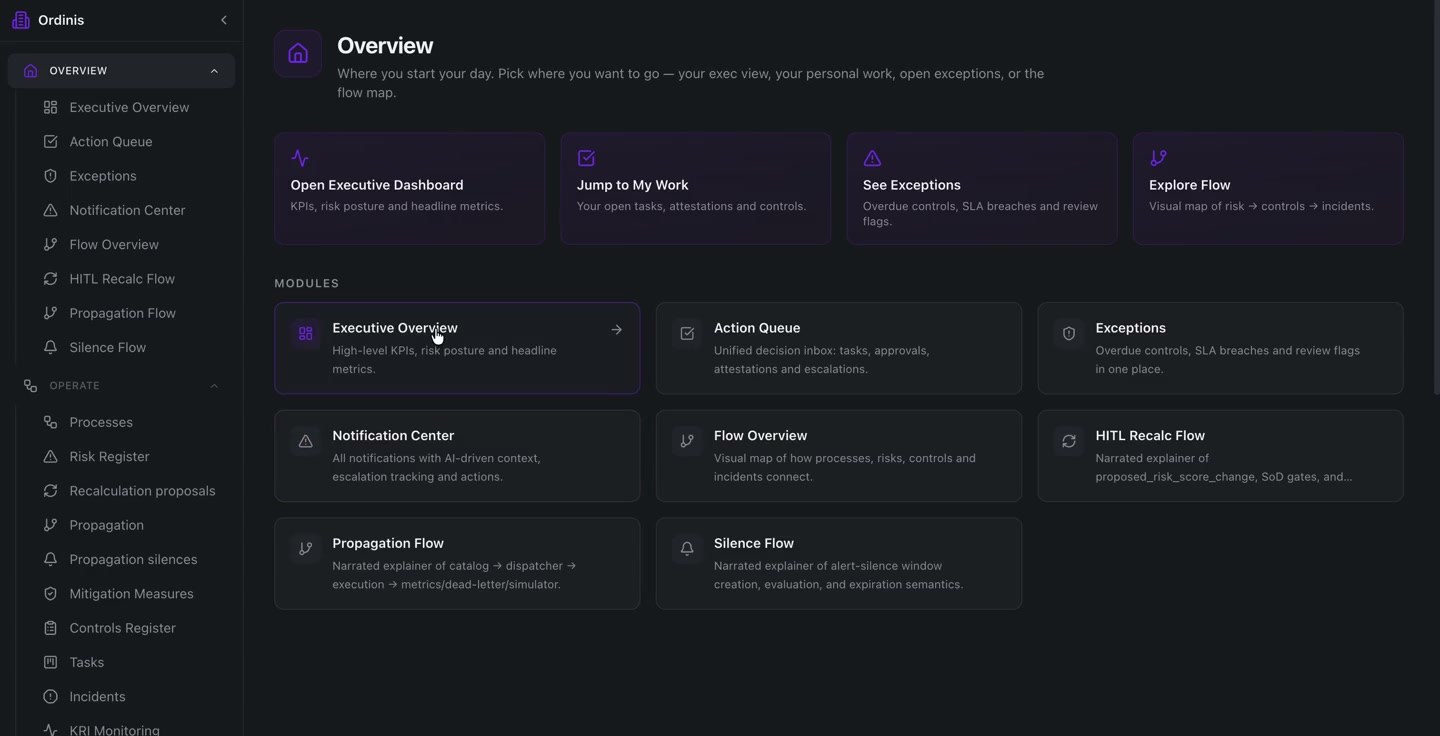
Ordinis executive overview. Representative UI preview · values synthetic · not a live customer environment. -
The internal documentation has to give a reliable picture of the business.
Under FinIO Art. 33, internal documentation must let the audit firm, the supervisory organisation and FINMA form a reliable picture of the business activities. The firm sets out its organisation in organisational principles (FinIO Art. 12), its risk management guidelines and risk tolerance (FinIO Art. 26 para. 1), internal regulations for its FinSA duties (FinSA Art. 21), and AML directives and an AML risk analysis that the board or top management adopts (AMLO-FINMA Art. 25 and 26).
In Ordinis a directive is a policy with versions. When the board adopts a new version of the AML directives, the change reaches every control and attestation linked to it, with a written approval record at each step, and you can query whether it reached every control it applies to.
Re-review is queued automatically for the affected controls. Earlier signatures are kept unchanged, so the file shows which version applied at which time and who signed it.
-
Risk management may not sit with the people it supervises.
FinIA Art. 21 para. 3 says the persons who carry out risk management and internal control may not be involved in the activities they supervise. A firm is exempt from this independence if it has five or fewer full-time positions or annual gross earnings below CHF 2 million, and follows a business model that is not high-risk (FinIO Art. 26 para. 2). Separately, two authorised signatories sign jointly (FinIO Art. 23 para. 1).
Segregation-of-duties and policy validators run before an approval in Ordinis, and a conflict blocks the request with a traceable reason. Human sign-off follows, with dual-control and escalation rules where the policy requires them.
A small firm that uses the exemption still records who reviewed what: each review is an attestation with its evidence, kept in the same append-only audit trail.
-
An outsourced control function stays the firm's responsibility.
FinIA Art. 21 para. 2 lets a firm hand risk management and internal control to a qualified external entity. In June 2026 FINMA reported that smaller institutions often outsourced these functions to providers that do not require authorisation, and that in escalated cases this produced standardised rather than individual controls, unclear responsibilities and control gaps. The firm remains responsible (FinIO Art. 17 para. 1) and must at all times have the resources and specialist knowledge to monitor the outsourced work (FinIO Art. 16 para. 3).
Ordinis keeps the firm's side of that oversight. A delegated control stays a record with an owner inside the firm, the review of the provider's work is an attestation with its evidence, and the provider sits in the vendor inventory, recorded as changes are made.
Not covered: Ordinis is software. It does not perform the risk management or compliance function, which stays with the firm or the qualified external entity it appoints.

What you can check.
-
ISO/IEC 27001:2022
Company-level ISMS certification by NQA under UKAS accreditation, certificate No. 215646, valid 21 Oct 2025 – 21 Oct 2028. The 2026 surveillance audit was passed.
View the certificate
Where the capabilities come from.
Frequently asked questions.
-
How many licensed portfolio managers and trustees are there in Switzerland?
About 1,600. FINMA's lists, updated 22 November 2026, show 1,509 portfolio managers and trustees monitored by a supervisory organisation and 90 domestic group companies that FINMA supervises directly.
-
Who checks a portfolio manager's compliance?
A supervisory organisation that FINMA has authorised carries out ongoing supervision, and an audit firm appointed by the manager audits it, unless the supervisory organisation audits itself. FINMA licenses the firm, can intervene, and is the only body that can issue enforceable decisions (FinIA Art. 61 and 62; FINMASA Art. 43a and 43b).
-
What does the supervisory organisation look at?
Compliance with FinIA, with the AMLA duties and, where the firm provides financial services, with the FinSA duties (FinIO Art. 84 para. 1). FINMA's risk assessment system for supervisory organisations is built around the same three acts.
-
How often is a portfolio manager audited?
Generally every year. The supervisory organisation may extend the cycle to up to four years for a low overall risk profile. In the years without an audit, the firm submits a report on compliance, possibly in a standardised format (FinIA Art. 62 paras. 2 and 3).
-
Do FINMA's bank circulars on governance and outsourcing apply to portfolio managers?
FINMA's indicative addressee table of 22 April 2025 does not list portfolio managers or trustees for Circulars 2017/1, 2018/3 or 2023/1. Their organisation, risk management and internal control rules sit in FinIA and FinIO.
-
Does Ordinis take over the compliance function?
No. Ordinis is software that records controls, policies, approvals and evidence. The risk management and compliance function stays with the firm or with the qualified external entity it appoints (FinIA Art. 21 para. 2).
Solutions for other clients
-
Swiss banks and FinTechs
FINMA-supervised banks and Art. 1b FinTech institutions.
-
Payment and e-money institutions
EU/EEA and UK payment institutions and e-money institutions.
-
Crypto-asset service providers
MiCA crypto-asset service providers and UK cryptoasset firms.
-
Swiss companies
Companies that keep their own books, and their accountants and fiduciaries.
-
All solutions
Every client type on one page.
Bring one finding from your last audit.
A control the audit firm questioned, a directive that changed, or an outsourced function you have to oversee. We will walk through how Ordinis records it.